The catalogue
A vocabulary, not a dropdown
Every word in this catalogue carries a description written by a person: what the craft looks like, where the motif sits, how the garment is built. That is what separates a list of names from something a render can be composed out of.
Names alone were the original bug. The prompt said “with dhoopchav handwork”, the model had never heard of dhoopchav, and it invented something — while the catalogue held, in its own note, warp and weft in different colours, so the cloth reads one shade in shadow and another in light. That sentence is a rendering instruction, and it was sitting in a column nothing read.
7 markets, and what is reachable in each
Garments belonging to each market. The spread is the honest part: India is deepest because it has been worked longest, Africa is newest and shallowest, and seven equal columns would imply a parity the catalogue has not earned yet. Depth is not standing — these are seven peers, not one home market and six exports.
All seven are switched on, the last of them on 25 September 2026. The switch is real and works both ways: a market that is off is off in the pickers rather than deleted, and designs already tagged to it keep their tags. Africa was opened once holding nothing and shut again the same day, which is why the mechanism exists.
- India178
- Indian diaspora163
- Europe122
- North America107
- Gulf / GCC84
- Southeast Asia78
- Africa60
Garments per market. All seven open.
25 regions inside them
India 14 · Europe 7 · Africa 4. A region is not decoration on a market: it is where a craft is worked differently, and it is the level at which that difference is recorded.
Europe’s seven: Italy, France, UK & Ireland, Iberia, Alpine, Nordics, Central & Eastern.
It was never only clothes
apparel · footwear · bags · belts · jewellery · headwear · scarves. Apparel is the largest at 159 of the 289, and the other 130 are not clothes — so a house that makes shoes, bags or jewellery is described here rather than accommodated. Each category carries its own making cost, because a sandal and a bridal lehenga cannot share one baseline.
The cut vocabulary deliberately stops at apparel — a shoe has a toe shape and a heel height, a bag has a gusset, and those are real vocabularies this one does not yet pretend to cover. Nor is there furniture, fragrance or eyewear: there are no rows for them, and lifestyle here means how a person is dressed for the whole of their life rather than a range that does not exist.
A garment that has a defining vocabulary is given one
When a brief names no craft at all, something has to fill the silence. It used to be one default for an entire market — “fine hand embroidery” and “traditional buta” — written when everything in the catalogue was a North Indian wedding garment, and quietly flattening every regional garment since.
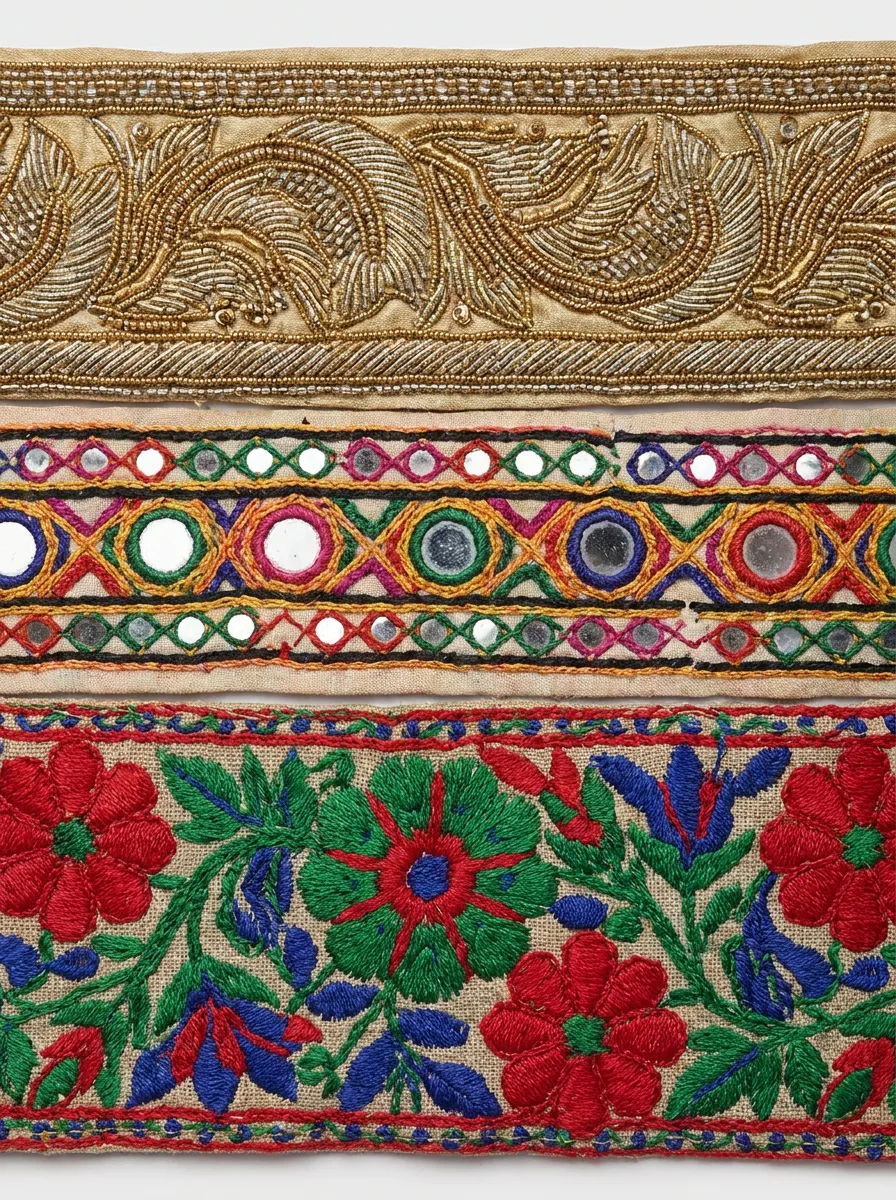
Now a garment with a genuinely defining vocabulary carries it. A chaniya choli gets mirror work, bandhani and gota patti, and the Kutchi folk motifs the same hands work — because abhla is the thing that makes garba dress read as garba dress, and a chaniya choli without it is a plain gathered skirt.
Three crafts at most, most defining first. A prompt naming eight describes none.
The rule that keeps it honest
A row is added only where somebody who knows the garment would say “well, obviously”. A lehenga is not in that file and must not be: it is zardozi in Delhi, gota in Jaipur and thread in Surat, and picking one would be inventing a fact and rendering it a thousand times.
An empty row is the honest answer for most of the catalogue.
Absence can be the identity
A Goan kunbi saree names no craft at all, deliberately: its whole identity is the red check and the absence of ornament. A Kerala mundu set is off-white cotton with a gold border and almost nothing else — adding embroidery there would be adding the thing the garment is defined by not having.
It went in for India and mattered more outside it. A shweshwe dress ordered with nothing chosen came back in a soft floral block print — an Indian cloth on a South African cut — because a note is a description and a chosen motif is an instruction, and with nothing chosen the model falls back on what it has seen most of. What it has seen most of is India. A wrong Indian render is a dull render; a wrong African one is an Indian garment sold as African.
The same craft, two hands
A regional manner replaces a craft’s own description rather than annotating it, so it has to describe the whole look of the work. It qualifies a craft the designer has already chosen, which means it can add nothing to the brief that was not already in it.
One rule governs every row: a manner says how, it never says what. “Lucknawi chikankari, worked in gold zari” would smuggle in an ingredient, and zari would render on a garment nobody asked to have zari on. A test scans every row for exactly that.
Zardozi
North — Delhi, Lucknow
Metal wire and coiled thread couched onto the surface in high relief, built up thick enough to catch light from the side, massed so densely that the ground cloth barely shows.
Gujarat — Surat
Flat metal thread laid close to the surface in fine outlines and open fills, the ground cloth visible between the lines, catching light evenly rather than in raised points.
Bandhani
Gujarat — Kutch
Very small tied dots packed in dense even rows, each one a tiny ring of undyed cloth with a coloured centre, the pattern reading as fine texture from a distance.
Rajasthan — Jaipur, Jodhpur
Larger tied dots set further apart on an open ground, arranged in clear figures and borders, each ring plainly visible as an individual mark.
Cutwork
Nordics
The ground cut away inside squared blocks of close flat stitching, every opening held to the grain, the threads left standing across them wrapped into bars and star-shaped fillings.
Italy
Openings cut in a regular grid and then filled again by hand — bars, rings and small wheels — so the cut areas read as drawn ornament rather than as plain holes in the cloth.
Chikankari is the clearest case in the catalogue: white cotton thread on white cloth, the pattern read as texture and shadow rather than colour, with the densest stitches worked from the reverse so the motif blooms through the ground. Coloured chikankari exists, and it is a later export habit rather than the Lucknow hand — so the catalogue says which one it means.
How a garment is cut, recorded as its own dimension
A design could be described along eleven dimensions — market, cloth, material, hardware, craft, motif, silhouette, occasion, region, gender, drape — and every one of them is about ornament or cloth. None described cut.
That is why a plain t-shirt drifted back into embroidered occasion wear: it carries no craft, no motif and no fitting, so there was almost nothing true left to say about it, and an image model reads silence as “unspecified” rather than as “none”. It is also why a Neapolitan jacket could not be told apart from any other single-breasted suit — Italian tailoring is construction, and there was nowhere to record a shoulder or a lapel.
Twelve kinds, one master: neckline, sleeve, collar, shoulder, lapel, fit, length, rise, leg, hem, placket, wash. They are twelve questions about one garment, and a category is only asked the ones that apply to it.
Each is written as appearance, because a name is not an instruction. “V-neck” tells a renderer nothing it did not already assume; a neckline meeting in a point at the breastbone, the two edges running straight from the shoulders tells it which of several to draw.
Every dimension, and what it is for
- 289garment styles
- Each held as itself. An abaya is not a kaftan and a shayla is not a dupatta.
- 225crafts
- Described by appearance, so the brief can say what the work looks like rather than only its name.
- 150occasions
- A garba night and a job interview are both occasions, and neither is asked the other's questions.
- 109motifs
- With a placement — a border, an open ground, one placed figure — because a motif with nowhere to sit goes anywhere.
- 104cloths
- What the garment is made of, kept apart from what the fibre is.
- 95cuts
- Neckline, sleeve, collar, shoulder, lapel, fit, length, rise, leg, hem, placket, wash.
- 56materials
- The fibre before anything was done to it.
- 45fittings
- What a thing is built with rather than made of: a belt is leather and has a brass buckle, and both are true at once.
- 32traditions
- Descriptive, never a gate. A tradition is a way of searching, not a reason to hide a garment.
The limit
Most garments have no defining vocabulary and no construction rule, and are not given one. Of the sixty African garments, twenty are listed; the other forty are cut, drape and cloth weight, and naming a craft for them would be inventing one.
Regional manners exist only where the hand genuinely differs enough to see in a photograph. Most crafts are worked the same way wherever they are worked, and a manner written for the sake of completeness is a sentence that says nothing while costing the place of one that would.
The catalogue is the product.
If your house works in something this vocabulary holds badly, that is the most useful thing you could tell us. Say which crafts and which regions, and we will say honestly what is described and what is not.